
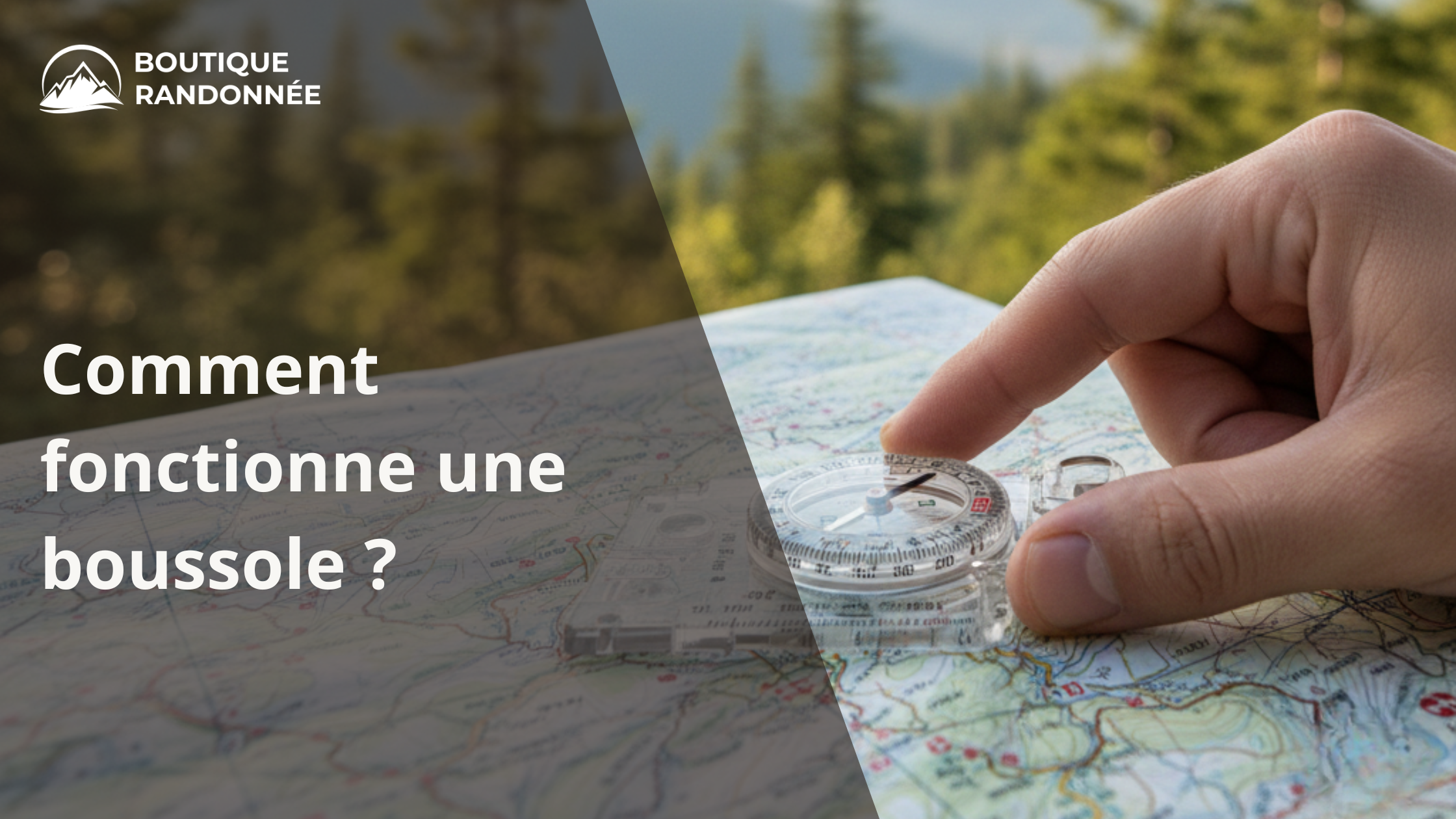
Simple, lightweight, and completely self-contained, the compass remains an essential navigation tool for any hiker. It doesn't depend on a battery, a network connection, or a screen. As long as you know how to read a map and use your compass, you can always find north and stay on course, even far from civilization.

Why use a compass when hiking?
When hiking , a compass offers a level of safety that electronic devices don't always guarantee. Phones and GPS devices can malfunction, run out of battery, or lose signal. A compass, on the other hand, works continuously . It allows you to regularly check your heading and avoid gradually straying from your route without realizing it.
Discover our selection of hiking compasses
Why does the compass always point north?
A compass contains a magnetized needle. The Earth itself behaves like a giant magnet, with north and south magnetic poles. The needle naturally aligns with the Earth's magnetic field, causing it to point towards magnetic north. This simple physical principle is what has made the compass reliable for centuries.

Magnetic North vs. Geographic North
The north indicated by a compass is magnetic north, which does not correspond exactly to true north. This difference is called magnetic declination. In Belgium, it is small, but in some parts of the world it can be significant. Modern compasses sometimes allow you to adjust this correction directly.
The different parts of a compass
Each element has a specific role in orientation:
- Magnetic needle : the red point indicates north
- Graduated compass rose : rotating ring in degrees
- Directional arrow : indicates the direction to follow
- Clue point : allows you to read the heading
- Base plate : transparent surface for reading the map

How do I use a compass with a map?
Using a map and compass together allows you to know precisely where you are and where you are going.
- Orient the map towards the north by aligning the compass with the north-south lines.
- Place the compass between your starting point and your destination.
- Rotate the compass rose to align the north of the compass with that of the map.
- Turn until the needle coincides with the north of the rose, then follow the arrow.

Beware of magnetic interference
The compass is sensitive to nearby magnetic fields. Metallic or magnetized objects can interfere with the needle and give incorrect directions. Keep it away from smartphones, watches, bicycles, metal buttons, or other magnets. Always hold the compass flat for accurate readings .
Navigating without a compass (as a last resort)
In an emergency situation, some natural landmarks can help, but they remain approximate:
- The sun indicates east in the morning and west in the evening
- Moss often grows on the north side of trees (but this is not reliable).
- Following a watercourse may lead to an inhabited area.
- Compare the landscape features with a map
Essential items to have with your compass
Good orientation goes hand in hand with appropriate equipment:
- Compass → View models
- Water bottle →Hydration systems
- First aid kit → See models
- Survival kit → See models

In summary
The compass works thanks to the Earth's magnetic field and never fails. Used in conjunction with a map, it remains the most reliable tool for navigation while hiking , especially off marked trails. Mastering its use means gaining independence, safety, and peace of mind.
Find all the necessary equipment at Boutique Randonnée .